


Walking past a table of people playing a complex card game can feel like you’re looking in on a secret society. They’re using strange words, flipping cards with a speed you can’t follow, and operating on a level of strategy that feels miles away. It’s easy to assume that a monstrous card game with dragons and zombies has a rulebook just as scary as its creatures. To know more, check out workfromhomecenter.com
But it’s all built on one simple, thrilling idea. This game isn’t about memorizing a thousand rules, but about a straightforward contest: your monsters versus theirs. If you’ve ever cheered for a giant movie monster or thought a skeleton army was cool, you already understand the heart of it. That deck of cards isn’t a complex puzzle; it’s an army of nightmares waiting for your command.
Everything you do in this game serves a single, clear purpose: to reduce your opponent’s health to zero. Every ghoul you summon and every spell you cast is another step toward that victory, chipping away at their defenses until your monster lands the final blow.
Consider this your invitation to join the club. This guide is your secret handshake, translating the spellbook one page at a time, starting with the absolute basics. By the end, you’ll understand the flow of the game and be ready to summon your very first creature.
What’s the Goal? Your Three Most Important Tools for Battle
Before you can summon a single ghoul or cast a wicked curse, you need to know what you’re fighting for. In any monstrous duel, the goal is elegantly simple: knock your opponent’s Life Points from 20 down to 0. Think of this as a health bar. Every hit you take brings you closer to defeat, so your entire strategy revolves around protecting your own life while blasting away at your rival’s. It’s the core tug-of-war that gives every move its thrilling stakes.
Of course, you’ll need an army to do your bidding. That army is The Deck, a stack of cards you’ve chosen for the battle ahead. This is your personal spellbook and monster menagerie all in one. Once the game begins, your deck is locked in—you can’t add new cards or swap them out mid-fight. This makes your initial choices important, as the cards in that stack are your only tools for achieving victory. Draw wisely, because every card is a precious resource.
As monsters are defeated and spells are cast, the used cards don’t just vanish. They’re sent to a special zone called The Boneyard. While it functions as a discard pile for your spent forces, it’s much more than a simple graveyard. It’s a record of the battle’s history, and clever players will find that some powerful effects can even reach into the Boneyard to call a fallen monster back for one more terrifying attack. Keep an eye on it—yours and your opponent’s.
How to Take Your First Turn in Under 60 Seconds
What actually happens during a turn is not some mystical ritual known only to seasoned players. It’s a simple, two-step rhythm that you’ll repeat every time it’s your chance to act. It all begins with fueling your dark magic and drawing a new secret from your deck.
To play any card, you need a resource called Gloom. Think of it as your magical budget for the duel. At the start of your turn, you automatically gain one Gloom, adding it to your pool. The best part? Any Gloom you don’t spend is saved for later. This means you can either play cheap monsters early on or patiently save up for a truly terrifying creature that costs a fortune.
After gaining your Gloom, your very next action is always the same: you draw one card from the top of your deck. This is the moment of possibility, the injection of fresh chaos into the battle. Will it be the monster you need to defend yourself, or the perfect curse to cripple your opponent? Every draw gives you brand-new options to consider for the fight ahead.
And that’s the core of your turn! You have new Gloom and a new card. The central puzzle you must solve is how to best use those resources. This choice between immediate power and future potential is what makes every turn exciting. But what exactly are you choosing between?
What Are the Different Monster Card Types in Your Arsenal?
Every card you draw from your deck falls into one of two monstrous categories, and knowing the difference is key to your battle plan. Think of it as choosing between raising a permanent army and casting a fleeting, powerful curse. Your deck is a mix of these two fundamental tools:
- Monster Cards: Your soldiers. They have Attack and Health stats and stay on the battlefield to attack and defend turn after turn, forming the core of your forces.
- Spell Cards: One-time effects. You cast it, the magic happens, and the card is immediately sent to your discard pile, The Boneyard. They’re perfect for surprise attacks or getting out of a tight spot.
But how do you know if you can afford to summon that hulking Gargoyle or cast that fiery curse? Take a look at the top corner of any card. The number you see there is its Gloom Cost—the price you must pay from your saved-up Gloom to play it. A simple “Grave-Rat” might cost only 1 Gloom, making it easy to play early. That terrifying “Shadow Dragon,” however, could cost 7 or more, requiring you to patiently save for several turns. This cost directly influences your deck building strategy, balancing cheap creatures with game-ending titans.
So, the choice each turn becomes wonderfully tactical. Do you spend your Gloom to put a permanent monster on the board, building your presence for future turns? Or do you unleash a powerful Spell for a sudden, game-changing advantage? This tactical trade-off is your first step toward mastery. Now that you know how to get a monster onto the field, it’s time for the fun part: telling it what to attack.
Let the Battle Begin: A Simple Guide to Monster Combat
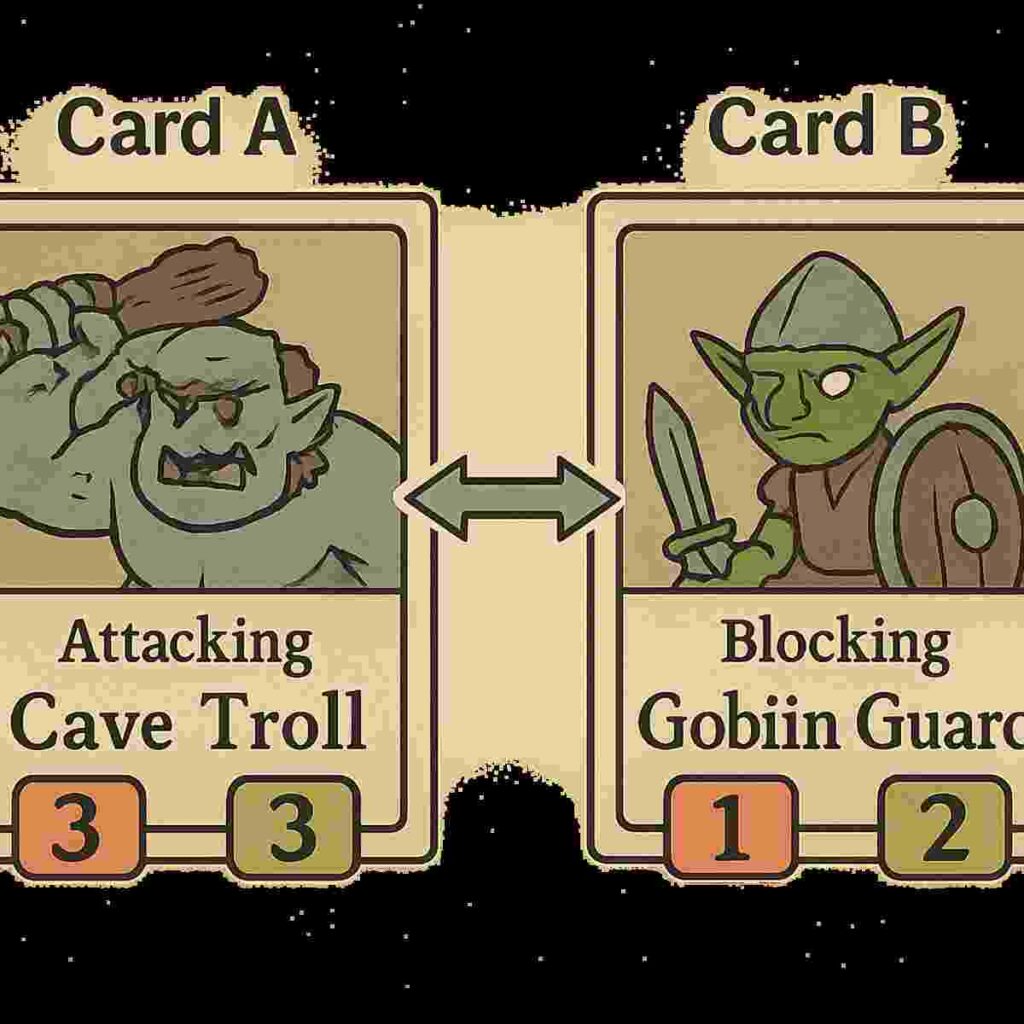
Unleashing your monsters is the most thrilling part of the game. You are the general, and you decide who fights. During your turn, you can declare an attack with any of your monsters that have been on the field since the start of that turn. You simply point to your creature—say, a hulking “Cave Troll”—and choose your target: either one of your opponent’s monsters or, if their side of the field is empty, their Life Points directly. You are in complete control of the offense.
Your opponent, however, isn’t helpless. They take on the role of the defender and get to make a crucial choice. If you attack their Life Points, they can command one of their own monsters—like a “Goblin Guard”—to leap in front of the attack and block. If they choose not to block (or can’t), your monster’s attack hits them directly, and their Life Points are reduced by your monster’s Attack value.
So what happens when two monsters clash? It’s beautifully simple. Both monsters deal damage to each other at the same time, equal to their Attack value.
In an example clash, your 3-Attack Cave Troll hits a blocking Goblin Guard (1 Attack, 2 Health). The Goblin only has 2 Health, so it’s defeated and sent to The Boneyard. At the same time, the 1-Attack Goblin gets a final swing in, dealing 1 damage to your Troll, which survives.
This constant back-and-forth of attacking and blocking is the heart of the game. It’s a tense calculation of risk and reward. Do you send your whole army in for a massive assault, or hold some back to defend on your opponent’s turn? The kinds of monsters you command will shape these decisions.
A Guide to Monster Factions: Which Army Will You Lead?
The monsters you command aren’t just a random assortment of ghouls and beasts; they often belong to powerful Factions. Think of these as a monster’s family or tribe. Sticking to one faction is a great starting point for your deck building strategy because their members are designed to work together, creating a clear and focused game plan. Choosing a faction is the first step in deciding what kind of monster master you want to be.
Take the Graveborn Legion, for example. This faction doesn’t believe in subtlety. Their strategy is to overwhelm the opponent with a relentless horde of cheap, disposable creatures like shambling zombies and screeching skeletons. A Graveborn player wants to spend their Gloom every single turn to fill the battlefield with a tidal wave of small monsters. While no single creature is a major threat, facing five of them at once is a nightmare for any opponent.
On the other hand, you have the stoic Abyssal Watchers. These creatures of the deep are the complete opposite, favoring patience and immense power. An Abyssal player might spend their first few turns simply defending and saving up their Gloom. They are content to weather the early storm, because they know they can eventually summon a single, colossal sea beast that is nearly unstoppable. Their goal isn’t to win with a thousand small cuts, but with one final, devastating blow.
Ultimately, your choice of faction shapes your entire approach to the game. Will you lead a fast, aggressive swarm, or will you patiently build towards an earth-shattering titan? Each offers a unique path to victory, and experimenting is the best way to find the one that feels right for you.
What Do Card Rarity Levels Mean for Your Deck?
As you start collecting cards and building your monster army, you’ll notice a small symbol at the bottom of each one. This isn’t just for decoration; it’s a clue to the card’s rarity, telling you how likely you are to find it when cracking open a new booster pack. Understanding card rarity levels is key to assembling a balanced force. Generally, they break down like this:
- Circle (Common): The reliable backbone of your army. You’ll see these frequently.
- Diamond (Rare): Often have unique and complex abilities that can surprise an opponent.
- Star (Mythic): Game-changing cards that are very hard to find. Pulling one of these from a pack is a major event!
It’s tempting to think that a deck full of sparkling Mythic cards is the ultimate goal, but that’s a common trap for new monster masters. The truth is, rarity is about frequency, not necessarily raw power. Think of it like building an actual army: you need a solid core of dependable soldiers (Commons) to support your elite, specialist champions (Rares and Mythics). A handful of powerful generals is useless without an army to command.
Your Common cards are often the most straightforward and efficient tools you have, forming the essential foundation of your game plan. Rares and Mythics, while exciting and powerful, can be more situational and require careful planning to use correctly. Their scarcity also gives them higher collectible values, making them thrilling to discover. The real skill is learning how to combine these powerful specialists with your common foot soldiers to create a truly fearsome force.
How to Build Your First Monster Deck Without Getting Overwhelmed
Staring at a growing pile of monstrous cards can feel as daunting as facing a dragon with nothing but a pointed stick. Which ones do you choose? How many is too many? The good news is that you don’t have to figure it all out at once. Your first step into commanding a legion of horrors is actually incredibly simple.
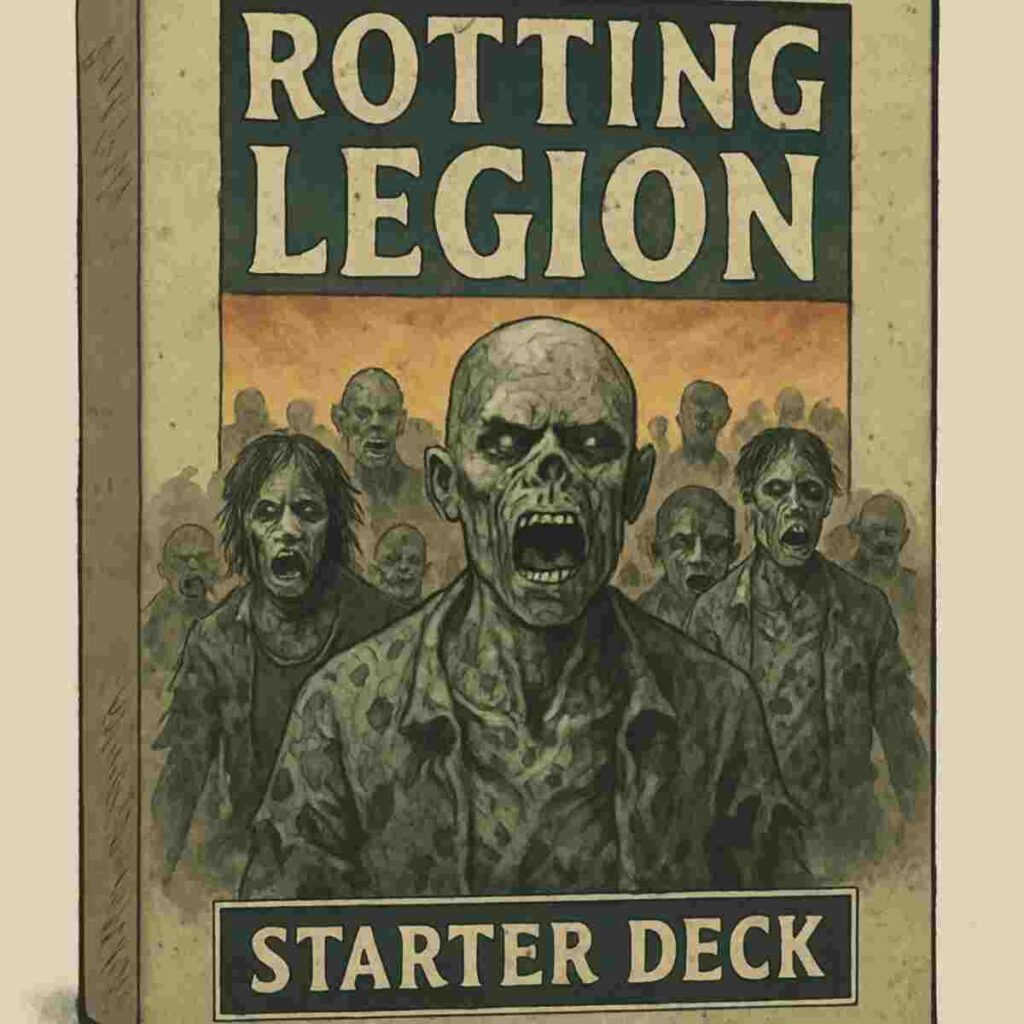
The easiest path forward is a Starter Deck. Think of it as a complete army in a box, hand-picked by the game’s creators to work well together. These pre-built decks, like the popular “Rotting Legion” set shown here, are designed to be balanced and playable right out of the gate. By using one, you’ll get a natural feel for how different cards support each other without the pressure of making a “wrong” choice. It’s the perfect training ground for any new monster master.
When you feel ready to build your own legion from scratch, you don’t need a complex formula. Just aim for a 40-card deck to start. A great rule of thumb for your first deck is to aim for a simple ratio: about 60% Monsters and 40% Spells. For a 40-card deck, that means around 24 monsters to do your bidding and 16 spells to support them. This balance ensures you always have creatures to play while still holding a few tricks up your sleeve.
To give your custom deck a real edge, try building it around a single Faction, like the shambling Undead or the fiery Dragons. Cards within the same faction are designed to work together, like members of a team who all speak the same language. A deck focused this way will be far more consistent and powerful than one made from a random pile of your coolest-looking cards.
5 Beginner Mistakes to Avoid in Your First Monster Battles
Your monstrous legion is ready, and the battlefield awaits. To command your army with confidence, it helps to be aware of a few common illusions about how to win. What seems like a smart move can sometimes be a trap that leaves you defenseless.
A hand full of powerful monsters feels safe, leading many new players to hoard their smaller creatures. You might be tempted to hold onto your cheap “Grave-Rats” while waiting for enough Gloom to summon a mighty dragon. But monsters on the board are almost always more valuable than monsters in your hand. Playing a small creature early forces your opponent to react to your moves, disrupting their plan from the start. A constant trickle of damage from small threats can be far more effective than waiting for one big punch.
On the other side of that coin is the urge to spend every last drop of Gloom you have each turn. It can feel wasteful to end your turn with unspent resources, but patience is a powerful weapon. Deliberately saving your Gloom for a turn or two allows you to unleash a much bigger threat than your opponent is prepared for. Think of it as a gruesome savings account—spending it all on small spells feels busy, but saving up for that one game-changing behemoth can be the move that wins the battle.
The battlefield can become a chaotic mess of claws and fangs, making it easy to get tunnel vision. It’s incredibly satisfying to have your monster crush an enemy creature, but never forget the real goal: your opponent’s life total. Before every attack, ask yourself, “Can I hit my opponent directly?” Sometimes, ignoring their monster to land a direct blow is the smarter play. Likewise, always take a moment to read the cards your opponent plays. You might spot a weakness to exploit or a terrifying ability you need to neutralize immediately.
Avoiding these traps boils down to a simple shift in thinking. It’s not just about playing the biggest monster, but about playing the right one at the right time. Understanding when to apply pressure, when to save resources, and when to go for the win is the true mark of a monster commander.
Digital vs. Physical: Which Way to Start Your Monstrous Collection?
Now that you grasp the monstrous strategy at play, a new question rises from the crypt: where do you wage these battles? The game exists in two realms—the classic world of physical, printed cards shuffled by hand, and the modern convenience of a digital version on your computer or phone. Your first step as a commander is choosing which battlefield to enter first.
Opting for physical monster card collecting offers a satisfaction that a screen can’t replicate. There’s a special thrill in cracking open a fresh pack, holding a rare foil card in your hands, and physically laying your army on the table. This path also leads you to local game stores, the real-world crypts where you can find fellow players, trade for that elusive dragon you need, and feel the energy of a face-to-face match. Your collection becomes a real, tangible asset—a grim library of your favorite fiends.
On the other hand, the digital version offers unparalleled convenience and a gentler learning curve. You can find a match in seconds, day or night, without leaving your lair. More importantly for a new player, the game handles all the rules for you. There’s no forgetting to draw a card or miscalculating damage; the system guides you, letting you focus purely on strategy. For anyone worried about an initial investment, digital play is almost always cheaper—and often free—to start.
Ultimately, you don’t have to pledge allegiance to just one realm. The digital vs. physical collecting debate is less a war and more an alliance. Many commanders use the digital game as a training ground, testing new deck ideas and honing their skills without spending a dime. When they discover a strategy they love, they then seek out the physical cards to bring their master plan to life. You can have the best of both worlds: the convenience of the screen and the tangible thrill of the tabletop.
You’ve Mastered the Basics—Here’s Your Next Monstrous Quest
Not long ago, the monstrous world of this game was a locked crypt, its secrets guarded by strange words and complex rules. But now, you hold the key. You understand the goal is not just survival, but domination. You know how to summon forth creatures from the shadows, how to command them in the heat of battle, and how to assemble your very first army. The core power to play a full game is officially yours.
Your next quest is to expand your unholy legions. A quick search for a monster card expansion pack list will reveal all the new monsters and spells you can recruit. For true mastery and fellowship, seek out a friendly local game store. The veterans there are the best source for everything from tips on where to find rare monster cards to a casual introduction to official tournament rules and formats. Each new player makes the community stronger.
Remember that every card you draw and every monster you summon is a chance to tell a story. The rules you’ve learned are simply the stage; the real magic comes from the thrilling victories, the narrow escapes, and the epic clashes you create along the way. Your opponent is waiting. Go give them a tale to remember.